
 EN
EN



A Facility Planner's Discovery
A sports facility planner in Southeast Asia once faced a common problem: his padel courts were packed every evening and weekend, but the daytime hours sat empty. The numbers didn't add up. He surveyed the local community and discovered a large youth football community that needed indoor training facilities during weekday afternoons. He added a futsal court to the facility, converting the 8-am-to-5-pm dead time into a revenue stream. The padel courts remained busy during peak hours, and the futsal court filled the off-peak schedule. The facility's annual revenue jumped by 40%. That experience taught him that the value of a multi-sport facility is not just about adding more courts—it's about matching the right sports to the right time slots.
The Demographic Mismatch That Costs Money
Every facility manager knows the problem: padel players are typically adults with day jobs. They play during lunch breaks, evenings, and weekends. The court sits idle during standard working hours. Futsal appeals to a different audience—youth teams, university students, and amateur leagues that train on weekday afternoons . By adding futsal to a padel facility, the operator taps into a market segment that values daytime hours. In Aberdeen, the owners of Strikers indoor sports centre actively pursued this strategy when they added a third padel court and a dedicated multi-use indoor court to their facility, aiming to create a "more inclusive, multi-sport environment for people of all ages and abilities" . This approach not only fills off-peak hours but also builds community loyalty across different age groups.
The Revenue Math That Works
The financial logic is clear: futsal fills the hours that padel cannot. A padel court in Indonesia can command 250,000 to 450,000 rupiahs per hour during peak times, but it may sit empty for five hours a day on weekdays . A futsal court, meanwhile, can generate 50,000 to 150,000 rupiahs per hour. The combined revenue from a facility that operates both sports will consistently exceed a facility that operates only one. The owner of a facility in Bekasi who renovated his futsal venue to add padel expects to earn three to four times more from the same footprint . The message is clear: a single-sport facility leaves money on the table.
The Engineering Behind Multi-Sport Versatility
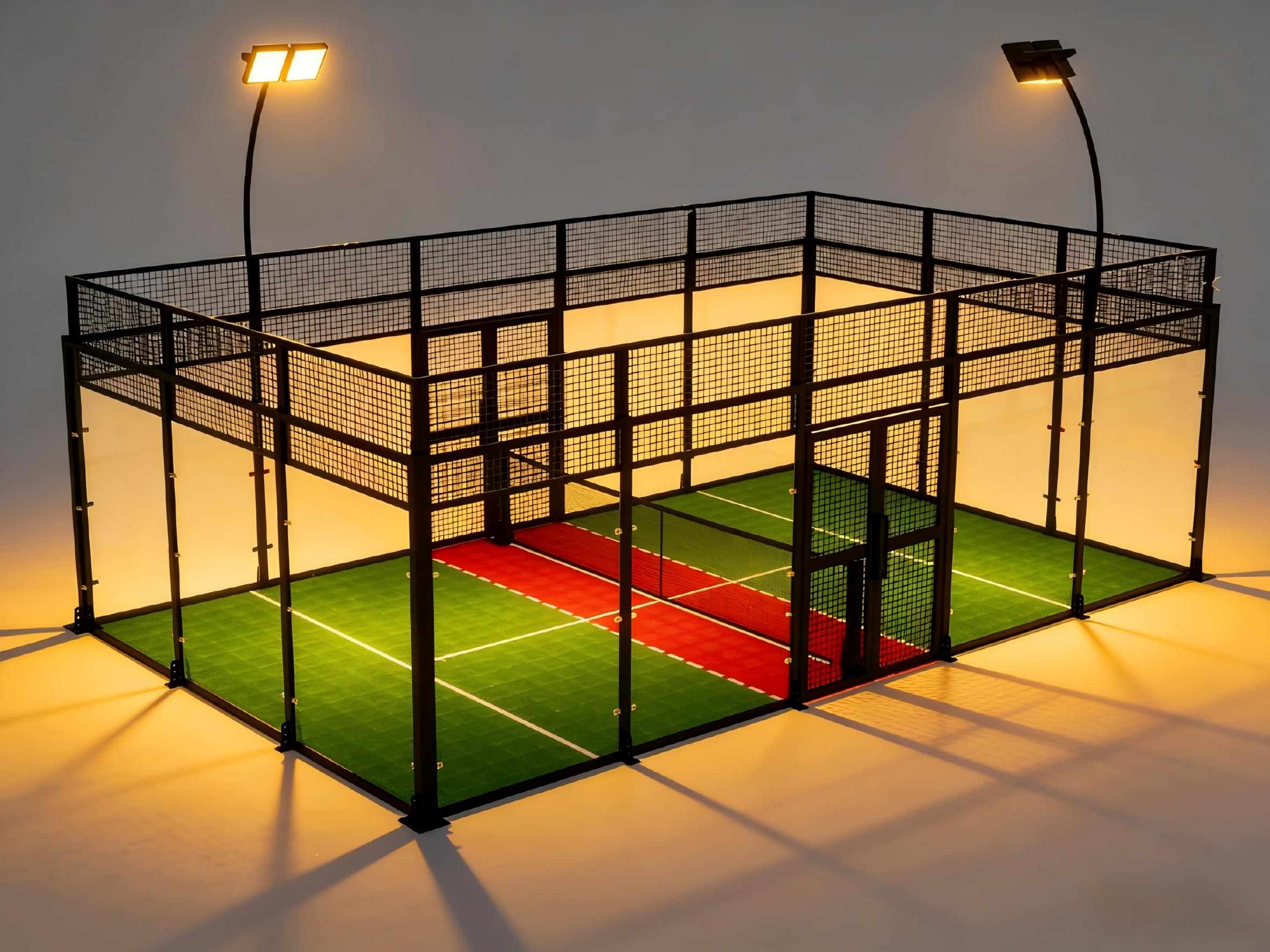
Creating a court that works for both padel and futsal requires precision manufacturing and careful design. Padel demands a 20-by-10-meter enclosed court with glass walls for rebound, while futsal needs a hard court surface with regulation lines for football. The structure must withstand the impact of a football hitting the fence at high speed, while the glass must be strong enough to absorb a player's impact. A Spanish residential community solved this challenge by installing a 5-in-1 multisport court that accommodated padel, futsal, basketball, tennis, and volleyball within the same 200-square-meter footprint . The project integrated futsal goals into the fence design and used high-density artificial grass suitable for both sports. This hybrid approach allowed the community to serve adults and teenagers without expanding the land.
Shared Infrastructure and Lower Costs
From an investment perspective, a multi-sport facility offers significant infrastructure synergies. The same roof, lighting system, changing rooms, and parking can serve both user groups. A facility built for padel can accommodate futsal courts underneath the same roof, often with minimal additional investment. The cost per sport decreases as the facility diversifies, making the business model more resilient. Facilities that offer multiple sports can also host a wider range of events—tournaments, leagues, corporate events, and school programs—increasing the facility's visibility and community role.
The Long-Term Advantage of a Versatile Venue
A facility that adapts to changing market conditions is a facility that survives. Padel may be growing rapidly, but it will eventually reach market saturation. Futsal, with its established youth and amateur base, provides a stable anchor in the facility's revenue mix. A facility that offers both is not dependent on the popularity of a single sport. It is a community sports hub that serves multiple needs. As one industry observer put it, "the future of sports facilities lies in diversification, not specialization."
The Manufacturing Partner That Delivers
A well-planned multi-sport facility requires a manufacturer that understands the technical demands of both sports and can deliver integrated solutions. Whale Sports, with over a decade of experience and a global footprint across more than 50 countries, offers the engineering expertise and production capacity to deliver courts that meet the highest standards for both padel and futsal [citation:client website]. Their advanced manufacturing technology, including precision CNC machining and automated production lines, ensures consistent quality across every component. By providing comprehensive solutions from design to installation, Whale Sports enables facility owners to create versatile venues that maximize their investment and attract a diverse playing community.