
 EN
EN


A Player’s Wake-Up Call
A few months ago, a padel player in Spain had a close call that completely changed how he thought about court safety. He lunged for a ball near the glass wall, lost his footing, and crashed shoulder-first into the panel. Instead of shattering into dangerous shards, the glass flexed and held. The player walked away with nothing more than a bruise. The court’s engineer later explained that the 12mm tempered glass was certified to EN 12150 standards, designed specifically to absorb impact without breaking apart. That moment drove home a simple truth: safety in padel is not accidental—it is engineered into every single component, and cutting corners on equipment can have serious consequences.
The Glass That Protects Players
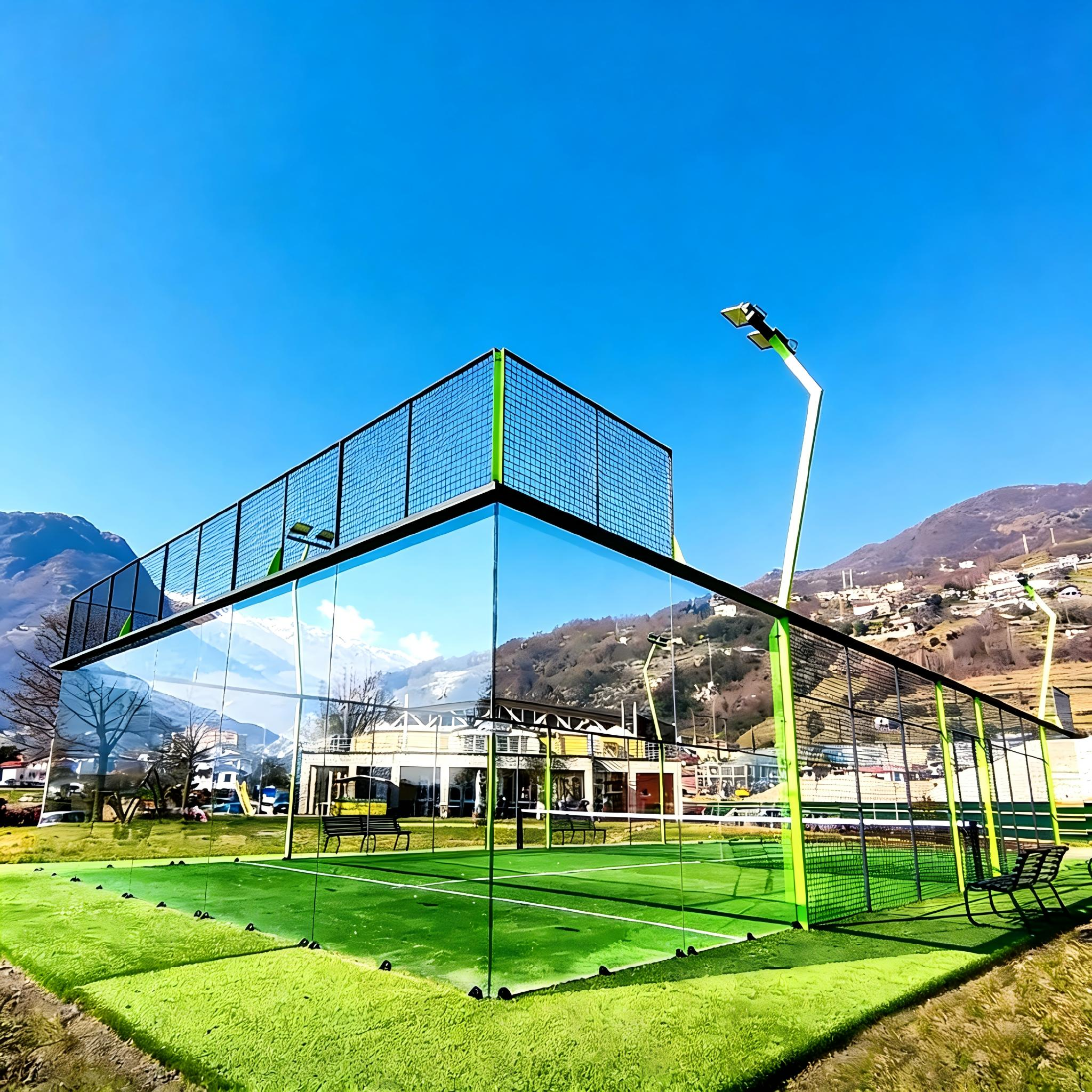
The most critical safety component on a padel court is the glass. Padel is defined by its wall rebounds, and players frequently collide with the glass during rallies. Substandard panels pose a serious injury risk—they can shatter under impact or fail to absorb the force of a collision. Professional courts use 12mm toughened safety glass that must comply with standards like BS EN 12150 and achieve impact resistance classification EN 12600 (Class 1C1). Heat soak testing to EN 14179-1 is also recommended to prevent spontaneous breakage caused by nickel sulfide inclusions, which can occur without warning even years after installation. For projects in extreme environments, laminated tempered glass provides an extra layer of security—it holds together even if cracked. The glass panels must feature permanent etched certification marks, not removable stickers, to verify compliance. Whale Sports’ Panorama Series, for example, uses 12mm laminated tempered glass with over 91% light transmittance, meeting Europe’s highest impact safety standards.
The Frame and Structural Integrity
A padel court’s safety depends on more than just its glass. The steel frame must withstand constant ball impacts, the force of players colliding with the enclosure, and environmental stresses like wind and corrosion. Hot-dip galvanized steel, coated to BS EN 10346 and BS EN 13438 standards, provides superior corrosion resistance and structural longevity. For coastal projects, marine-grade C5 protection is essential—salt spray can degrade unprotected steel within months, compromising the entire structure. For facilities in hurricane-prone regions, certifications like EFC-4 wind resistance are critical; they demonstrate that the court can withstand wind speeds of up to 55m/s. The frame’s design matters just as much. Ultra-thick pillars and flush-mounted mesh panels prevent protrusions that could injure players, and every component should undergo rigorous multi-stage inspections to ensure conformity to safety standards.
The Role of Safety Standards and Certifications
The padel industry is moving toward formalized safety standards, and certifications provide objective assurance that a court meets minimum safety requirements. The International Padel Federation sets official playing dimensions and performance requirements. In Europe, CE marking is mandatory for construction products, confirming compliance with health, safety, and environmental standards. Spain’s national standard UNE 147201:2024 has paved the way for international regulation, and a new ISO standard, ISO/WD 25808, is currently under development to harmonize structural and user safety requirements globally. The standard will cover everything from structural integrity to the playing surface, net, and lighting. What this means for a club owner is simple: choosing a court with these certifications is not about ticking boxes—it is about ensuring that every player who steps onto that court is protected by the best available engineering standards.
The Turf and Player Protection
The playing surface is often overlooked in safety discussions, but it is critical for preventing injuries. High-quality artificial turf with a shock-absorbing pad reduces the load on players’ joints, helping to prevent overuse injuries and providing better grip during sudden movements. FIP-certified turf systems use monofilament fibers that provide consistent ball bounce and reduce the risk of slips and falls. The turf must also be UV-stabilized and weather-resistant to maintain its performance over time. In countries with specific safety standards like China’s T/WQTB 1002-2021, the turf must meet requirements for ball rebound rate (≥80%), impact absorption (≥20%), and anti-slip values (65–100 BPN) to ensure player safety. A high-quality turf system is not a luxury—it is a fundamental part of injury prevention.
The Manufacturer That Prioritizes Safety
Safety is not a feature—it is the foundation of any professional padel court. Choosing a manufacturer that treats safety as a non-negotiable standard is the most important decision in building a lasting, successful padel facility. Whale Sports, with over a decade of specialized experience and a global footprint across more than 50 countries, engineers its courts with safety as the highest priority. Their Panorama Series features 12mm tempered safety glass, hot-dip galvanized steel frames, and EFC-4 hurricane resistance certification. By combining advanced manufacturing technology with rigorous quality control and international certifications, Whale Sports delivers courts that protect players and investors alike. For a club owner or developer, that assurance is worth more than any price difference. When players step onto a court, they should never have to think about whether the equipment is safe—it is the manufacturer’s responsibility to make sure they don’t have to.