
 EN



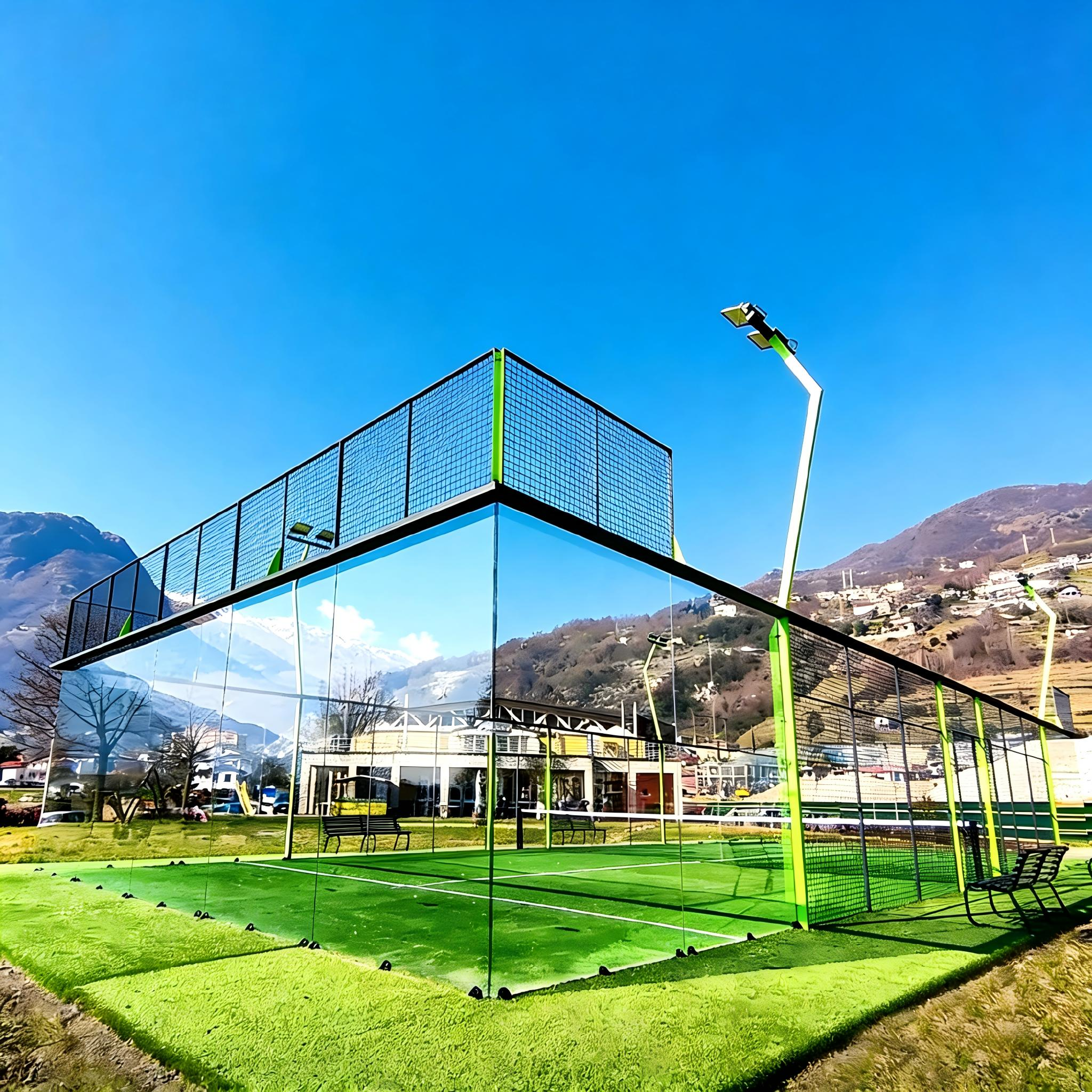
Court Dimensions and Space Requirements
Exact Measurements: Padel Court (10 × 20 m) vs Tennis Court (23.77 × 8.23 m for singles)
A regulation padel court measures exactly 10 meters wide by 20 meters long—200 m² of playing surface. This is nearly identical in area to a singles tennis court (23.77 m × 8.23 m = 195.7 m²), but the padel court is fully enclosed, while tennis relies on open space. A doubles tennis court expands to 23.77 m × 10.97 m (260.8 m²). For safe play, the International Padel Federation (FIP) requires a minimum clearance of 3 meters behind each baseline and 2 meters along the side walls for outdoor installations—bringing the total footprint to 26 m × 16 m (416 m²). Even with this buffer, a padel court occupies roughly 38% less land than a standard tennis court, which typically demands a 36.58 m × 18.29 m (669 m²) site. Indoor padel courts can operate within tighter perimeters—often just 11 m × 21 m (231 m²)—while still meeting FIP competition standards, underscoring their exceptional space efficiency.
Urban Adaptability and Installation Flexibility of the Padel Court
The compact size of a padel court unlocks unconventional venues: rooftops, repurposed warehouses, narrow urban lots, and even parking structures. Two full padel courts fit comfortably within the footprint of a single tennis court—effectively doubling booking capacity per square meter. Prefabricated steel-and-glass modules streamline construction, support temporary setups, and reduce permitting complexity. Indoor facilities require only a 6-meter ceiling height (8 meters recommended for elite play), enabling installations in basements or low-clearance buildings. This flexibility makes padel especially attractive for hotels, fitness centers, and residential developments seeking high-traffic amenities without large land parcels or major infrastructure investment.
Enclosure System and Wall Functionality
Glass, Mesh, and Structural Standards Defining a Legal Padel Court
A legal padel court must be fully enclosed. Back walls stand 3 meters high; side walls rise to 4 meters. The lower portion consists of tempered glass panels—at least 10 mm thick—that comply with international safety standards to resist shattering on impact. Above the glass, metallic mesh fencing extends the enclosure to full height, with openings no larger than 5 × 5 cm to retain the ball during play. Unlike tennis’s low perimeter fencing, padel’s integrated glass-and-mesh “cage” is not decorative—it defines the sport’s core mechanics. All structural components must withstand repeated ball impacts and environmental exposure, with the entire 20 × 10 m playing surface completely bounded by these walls.
Wall-Return Rules and Ball Dynamics: How Surfaces Shape Play
The enclosure fundamentally alters ball behavior: after bouncing once on the court, the ball may legally strike any wall—including glass or mesh—before being returned. Players must allow the ball to bounce before it contacts a wall; otherwise, the point ends immediately. This rule rewards anticipation, spatial awareness, and precise shot placement over raw power. Glass surfaces produce predictable rebounds, while mesh introduces subtle variability—adding tactical nuance to angles and pace. In contrast, tennis has no wall play: rallies end at the net or boundary lines. As a result, padel emphasizes geometry, redirection, and controlled aggression—turning every surface into an active element of strategy.
Net Height, Line Markings, and Service Zones
Net Specifications: 88 cm (Padel Court) vs 91.4 cm (Tennis) and Tactical Effects
The padel net stands 88 cm high at the center—3.4 cm lower than tennis’s 91.4 cm standard. This modest difference significantly influences rally dynamics. The lower net encourages aggressive volleying and sharper cross-court angles, while slightly diminishing the dominance of powerful serves. Shots that would graze or clip the net in tennis often clear cleanly in padel, extending rallies and elevating the value of consistency and placement. Defenders use lobs more frequently to reset points, confident that the reduced net height won’t truncate high-arcing returns.
The No-Volley Zone vs Tennis Alleys: Zoning Logic and Strategic Boundaries
Padel enforces a 3-meter no-volley zone—marked by a line parallel to the net—where players must let the ball bounce before striking it. This restriction prevents net-rushing dominance and incentivizes drop shots, lobs, and angled groundstrokes. In contrast, tennis alleys are static boundaries defining the 8.23-meter singles width; they remain inactive in singles but become critical offensive corridors in doubles. Both zoning systems shape movement, but differently: padel’s no-volley zone compresses decision space and encourages lateral repositioning, while tennis alleys expand strategic options depending on format—highlighting how court design directly informs tactical priorities.
How Padel Court Design Drives Distinct Gameplay
Padel’s court design creates a uniquely strategic, fast-paced, and inclusive game. At just one-third the surface area of a tennis court—and fully enclosed—the playing field compresses reaction time and amplifies the importance of anticipation and footwork. Every shot can rebound off glass or mesh, transforming potential winners into extended rallies. This dynamic rewards angled volleys, soft drop shots, and well-placed lobs—not just power or spin. Unlike tennis, where strong servers often dictate early points, padel rallies regularly extend to 10–15 exchanges, emphasizing consistency, positioning, and reading opponents’ intentions. Players must constantly adjust for wall returns, blending squash-like spatial reasoning with tennis fundamentals. Ultimately, the court itself functions as an active participant—shaping a sport that balances athleticism with accessibility across age and ability levels.
Frequently Asked Questions (FAQ)
What are the dimensions of a padel court compared to a tennis court?
A padel court measures 10 x 20 meters (200 m²), while a singles tennis court is 23.77 x 8.23 meters (195.7 m²). However, padel courts are fully enclosed, unlike tennis courts.
Why are padel courts increasingly popular in urban areas?
Padel courts require less space, enabling installations in unconventional places like rooftops, narrow lots, or warehouses. Their adaptability appeals to developers seeking high-traffic amenities.
How does the enclosure system impact gameplay in padel?
The fully enclosed design allows the ball to rebound off walls, introducing unique tactics like angled volleys, redirection, and spatial awareness that don't exist in tennis.
How does the padel net differ from a tennis net?
The padel net stands 88 cm high at the center—3.4 cm lower than the tennis net—facilitating sharper angles and extended rallies compared to tennis.