
 EN


Superior Safety and Structural Integrity
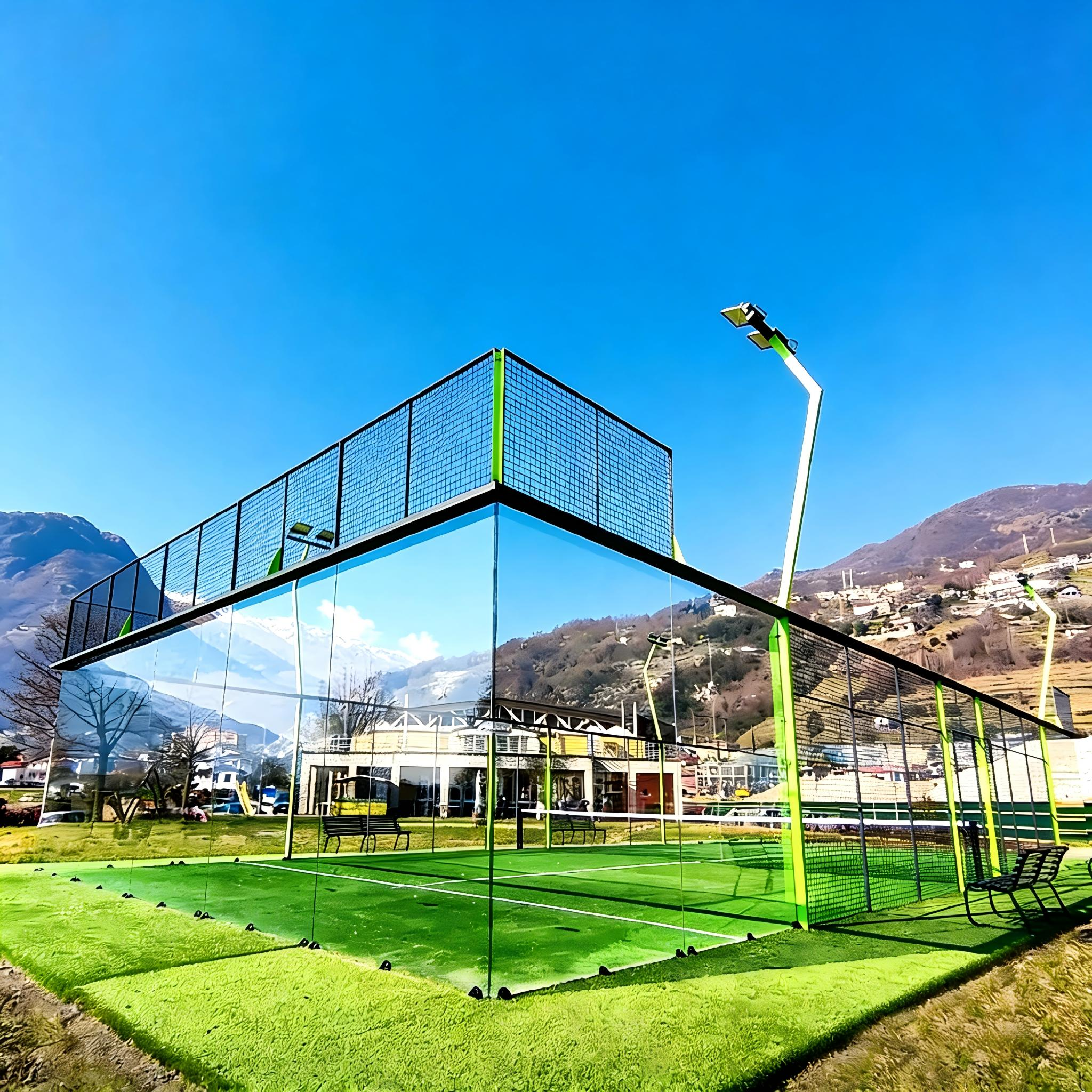
Professional padel tennis court equipment must deliver measurable protection for players, spectators, and the surrounding structure. Certified materials and tested connections reduce injury risk while keeping the court stable under fast rallies and changing weather.
Tempered glass panels: impact resistance and EN 12600-certified safety performance
Tempered glass panels are heat-treated to create compressive surface stress of at least 69 megapascals (MPa), making them roughly four to five times stronger than standard annealed glass. In EN 12600 pendulum impact tests, certified panels meet the 2B2 classification—withstanding high-energy ball strikes and breaking into small, relatively harmless fragments if overloaded. Most professional installations use 10 mm or 12 mm panels, selected based on span, wind load, and site conditions. The glass maintains structural integrity after repeated impacts exceeding 150 km/h without cracking from concentrated shock. Flexible gaskets and edge protection prevent direct contact with steel frames, eliminating stress points that could compromise durability. This combination protects players during aggressive rallies and minimises downtime from panel replacement.
Galvanized steel frameworks: corrosion resistance across humid, coastal, and continental climates
Galvanized steel posts and beams use a hot-dip zinc coating—typically 55–85 microns thick per EN ISO 1461—to protect against moisture, oxygen, and chloride exposure. This supports 20–40 years of low-maintenance service in moderate environments. Humid inland sites face condensation and dew cycles; coastal locations add salt-laden air that accelerates corrosion; continental zones introduce freeze-thaw stress at weld joints. The sacrificial zinc layer continues protecting even where minor scratches occur. In aggressive C5 coastal zones, operators often apply a duplex polyester powder topcoat or specify thicker zinc layers. Regular washdowns remove salt deposits and extend frame life—reducing repainting, section replacement, and unplanned closures.
Wind-stable anchoring systems validated to EN 14904 for panel bracing and foundation reliability
Anchoring systems secure glass panels and steel posts to the foundation against lateral wind gusts and repeated player impact loads. Professional installations embed posts in reinforced concrete footings and fix them with galvanized base plates; glass panels sit in adjustable aluminum U-channels. Load testing per EN 14904 verifies resistance to horizontal displacement, panel chatter, and vibration loosening over time. Engineers calculate wind pressure using local basic wind speed and exposure category, then specify anchor bolt diameter, embedment depth, and concrete grade accordingly. This prevents frame racking and foundation fatigue under dynamic loading. A stable system also preserves door gaps and panel alignment within tolerance—safeguarding both play quality and spectator safety.
Consistent, High-Performance Playing Conditions
Precision-engineered rebound dynamics: standardized glass height, net tension, and surface uniformity
Professional padel courts follow UNE 41901-1:2017 or FIP guidelines for consistent rebound behaviour. Tempered glass panels are typically 12 mm thick, with back walls at 3 m and side walls at 4 m. Net height is calibrated to 0.88 m at the centre and 0.92 m at the posts. Tension is set so a match-speed ball rebounds predictably in angle and pace. Certified installers align panels vertically and level the sub-base to eliminate dead spots. Underlayment and floor planarity are verified with a straightedge—deviations limited to a few millimetres across the full 20 m × 10 m playing area. Rebound testing at multiple points confirms uniform ball response. Competition venues, recreational clubs, and coaching academies rely on these tolerances to ensure practice drills translate directly to match play—reducing unexplained bounce variation and helping players read shots earlier.
Certified artificial turf: optimal softness, traction, and injury-reducing shock absorption
Certified padel turf meets EN 15330-1:2013 for shock absorption, vertical deformation, and rotational resistance. A properly certified surface limits peak vertical impact forces while enabling controlled sliding for lunges and direction changes. Excessively soft turf can cause foot lock; overly hard surfaces increase stress on knees and ankles—certification ensures balance. Test methods measure force reduction and energy restitution to maintain consistency across the court and over its lifespan. High-quality turf uses non-abrasive fibres and UV-stable coatings to preserve traction in wet or dry conditions, reducing slip-related falls and maintaining playability year-round. Players commit to full-speed stops and lateral cuts with confidence—the surface neither grabs excessively nor slides unpredictably. This lowers acute lower-limb injury risk and supports longer, safer sessions—especially valuable for recreational players who repeat high-impact movements without professional recovery resources.
Compliance, Long-Term Value, and Smart Customization
Choosing professional padel tennis court equipment means balancing certified safety, lifecycle cost, and future flexibility. Material selection and modular design drive long-term value.
Material selection trade-offs: tempered glass vs. polycarbonate (clarity, CE certification, lifespan)
Tempered glass remains the benchmark for professional courts. It delivers stable optical clarity, retains transparency for 15–25 years, and carries CE marking under EN 12150. Impact testing to EN 12600:2002 confirms it fractures into small, blunt granules rather than sharp shards—reducing injury risk. Polycarbonate offers high initial impact resistance and lower weight, but yellows or develops micro-scratches within 5–10 years. It lacks a comparable structural CE marking pathway, which can complicate compliance and insurance approvals.
| Factor | Tempered glass | Polycarbonate |
|---|---|---|
| Clarity retention | 15–25 years | 5–10 years |
| Impact safety | EN 12600:2002 fragmentation | High initial resistance |
| Compliance path | CE-marked under EN 12150 | Limited structural certification |
| Maintenance | Low; scratch-resistant | Higher; hazing and polishing |
This contrast directly affects long-term value and replacement frequency.
Modular design advantages: scalable layouts, color options, and integration-ready infrastructure
Modular court systems allow operators to scale from a single exhibition court to multi-court venues using standardized posts, panels, and flooring cassettes. This reduces installation complexity and supports phased investment as demand grows. Color-matched glass tints, turf markings, and post finishes support venue branding while preserving official dimensions and structural loads. Pre-installed conduits, anchor points, and low-voltage pathways simplify future LED lighting, electronic scoring, and streaming camera integration—without cutting into finished surfaces. Interchangeable components make replacement straightforward: a damaged panel or anchor can be swapped quickly, minimising downtime. For clubs and municipalities, this modularity transforms professional court infrastructure into an adaptable, long-term asset—not a fixed build.
Future-Ready Functional Upgrades
Integrated LED lighting: glare-free illumination, uniform lux distribution (≥200 lux), and energy efficiency
Professional padel courts increasingly feature integrated LED lighting engineered for glare-free visibility and uniform illumination of at least 200 lux. This supports safe, high-performance evening and indoor play by eliminating harsh shadows and visual fatigue. Compared with older halogen or metal-halide systems, LED fixtures offer higher energy efficiency, lower heat output, and extended service life. By treating lighting as part of the court system—not an afterthought—operators extend court availability while controlling operating costs. This approach delivers a future-ready upgrade that enhances both player experience and long-term sustainability.
FAQ Section
What materials are recommended for professional padel tennis court construction?
Tempered glass and galvanized steel are recommended for professional padel courts. Certified tempered glass ensures safety and durability, while galvanized steel provides excellent corrosion resistance and structural integrity.
Why is tempered glass preferred over polycarbonate?
Tempered glass offers greater clarity retention (15–25 years), CE certification, and safe fragmentation upon impact, making it a more reliable and long-lasting option compared to polycarbonate.
How does certified artificial turf improve safety?
Certified artificial turf meets specific standards for shock absorption and traction, reducing the risk of injuries like falls or excessive joint stress during intense movement.
What are the benefits of modular court design?
Modular designs enable scalable installations, brand customization, and easy future upgrades such as LED lighting or digital scoring systems. They are also simpler to maintain and repair.
What are the key advantages of integrated LED lighting for padel courts?
Integrated LED lighting provides uniform illumination, glare-free play, higher energy efficiency, and extended lifespan, enhancing player visibility and sustainability.
Table of Contents
- Superior Safety and Structural Integrity
- Consistent, High-Performance Playing Conditions
- Compliance, Long-Term Value, and Smart Customization
- Future-Ready Functional Upgrades
-
FAQ Section
- What materials are recommended for professional padel tennis court construction?
- Why is tempered glass preferred over polycarbonate?
- How does certified artificial turf improve safety?
- What are the benefits of modular court design?
- What are the key advantages of integrated LED lighting for padel courts?