
 EN



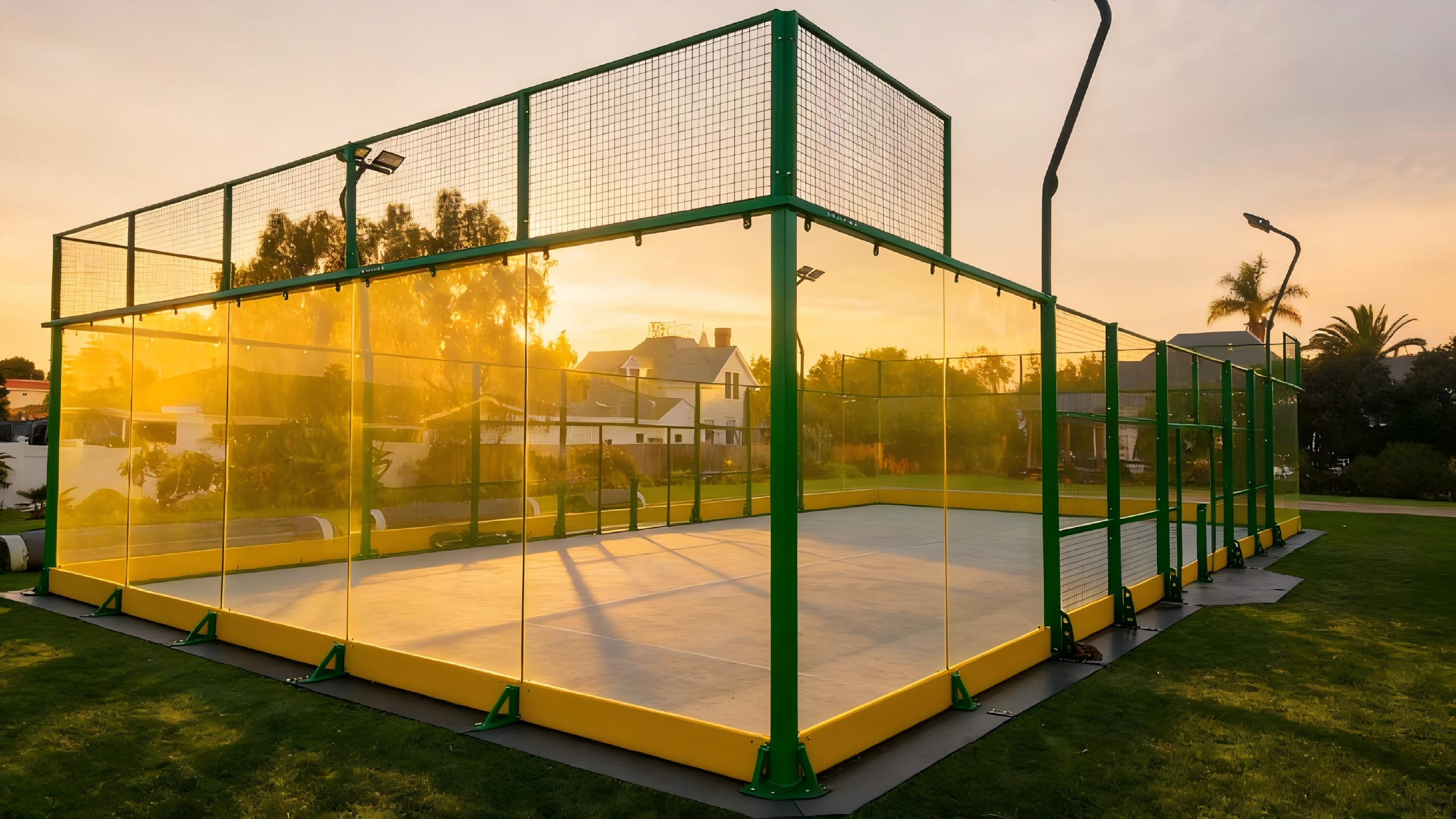
Padel Tennis Court Dimensions and Layout: FIP-Compliant Sizing and Zoning
Exact Inner-Wall Measurements (20m × 10m) and Why Outer-Frame Errors Cause Certification Failures
Every FIP-compliant padel tennis court is defined by an exact inner-wall rectangle of 20 m × 10 m, measured from the interior face of the wall system—not the outer frame or structural columns. FIP 2026 permits only a 0.5% dimensional tolerance: ±100 mm in length and ±50 mm in width. Common certification failures stem from builders aligning posts, glass panels, or mesh to the outside edge rather than the interior face. This misalignment shifts the playing area inward by 25–50 mm, distorting service box symmetry, reducing backcourt depth unevenly, and altering rebound angles across the court. Inspectors verify dimensions exclusively from the interior wall surface; even a 40 mm outer-frame squareness error can push the inner walls beyond tolerance. Correction often requires re-anchored footings, panel realignment, and full re-measurement—making precision in initial setting-out the most critical step toward certification.
Net Placement, Service Box Geometry, and Line Marking Precision per FIP 2026 Guidelines
The net must bisect the 20 m length into two equal 10 m halves, with its top cable tensioned to maintain strict height compliance. Per FIP 2026, each service line lies 6.95 m from the net, forming a service box that is 6.95 m long and 5 m wide, bounded on either side by the central service line—which itself divides the 10 m width into two symmetrical 5 m zones. Line marking occurs after wall and glass installation and must be verified using laser or total-station surveying. All lines are applied at 5 cm width, with deviation no greater than 2–3 mm over a 3 m straightedge. Misalignment exceeding this threshold—whether due to off-center placement, excessive paint thickness, or edge drift—renders the service box non-compliant. Tournament inspectors measure from the interior edge of each line, not the outer paint boundary, ensuring geometric fidelity directly impacts play fairness and certification readiness.
Glass Wall System: Safety, Structural Integration, and Ball Behavior Compliance
Tempered Glass Specifications: Thickness, Height Gradients, and Edge Treatment for FIP Certification
A certified padel court glass wall system must deliver safety, visibility, and predictable ball rebound. Lower panels use 10–12 mm tempered glass, independently verified to EN 12150 for controlled fragmentation under impact. Upper sections transition to 3–4 mm steel mesh fencing, maintaining airflow while containing high shots. The full enclosure reaches 4 m in height, with the glass-to-mesh transition occurring at a structurally reinforced zone designed to preserve uniform rebound behavior across the entire wall surface. All glass edges must be polished or rounded to eliminate micro-cracks and reduce stress concentration. Certified installers seat panels in UV-resistant, impact-dampening neoprene gaskets, preventing direct glass-to-metal contact and accommodating thermal expansion—key factors in sustaining consistent rebound and avoiding certification rejection due to untreated edges or inconsistent height transitions.
Fixing Systems, Gap Tolerance (<3 mm), and Vibration Control to Prevent Unintended Ball Deflection
Fixing systems must distribute dynamic impact loads across the steel frame—not concentrate them at bolt points—to prevent localized flex or panel displacement. Joint gaps between panels are strictly limited to <3 mm, with best-practice installations targeting ≤2 mm to eliminate deflection anomalies. The glass-to-frame interface is the highest-risk detail: UV-resistant neoprene gaskets absorb shock and prevent glass fracture under load, while flexible sealant maintains weatherproof integrity while allowing for thermal movement. Vibration control relies on rigid perimeter anchoring and gaskets engineered for controlled compression. Frames must resist ≥500 N lateral force without permanent deformation, ensuring net-adjacent walls remain stable during rallies. These integrated measures minimize unintended ball deflection and uphold the consistent, safe rebound behavior required for elite play and FIP certification.
Net and Supporting Structure: Height Accuracy, Tension Consistency, and Frame Rigidity
FIP-Required Net Dimensions (88 cm center / 92 cm posts), Cable Tension Protocol, and Post Anchoring
FIP 2026 mandates precise net geometry: 88 cm at center and 92 cm at posts, spanning the full 10 m width. This intentional gradient compensates for natural sag while preserving fair rally dynamics. The top cable must be preloaded to retain those heights after repeated ball impact, with visible sag limited to FIP’s allowable threshold. Mesh openings are standardized at 4 cm × 4 cm, and the bottom edge must sit flush with the playing surface—no gaps permitted. Posts require secure anchorage into either the court foundation or a reinforced base plate, with zero measurable lateral movement under load. Even minor post flex alters net height, tension distribution, and rebound consistency. Welded steel frames—or equivalent rigid construction—are mandatory; thin-wall tubing or undersized supports fail dynamic load testing. FIP certification includes both static and dynamic performance verification to confirm structural integrity under tournament conditions.
Playing Surface Selection and Installation: Turf vs. Acrylic Under FIP Performance Benchmarks
Artificial Turf Infill Standards, Subsurface Drainage Design, and Flatness Tolerance (≤3 mm over 3m)
Artificial turf remains the dominant FIP-compliant surface for outdoor padel courts, balancing controlled slide, responsive grip, and joint protection under elite competition benchmarks. Infill uses calibrated silica sand—typically 2,000–3,500 kg per court, adjusted for turf type (textured, fibrillated, or monofilament)—applied evenly and maintained via periodic raking to ensure consistent ball bounce and player traction. Beneath the turf, a porous or semi-polished concrete base with positive subsurface drainage prevents water pooling, surface softening, and long-term infill degradation. The finished surface must meet a flatness tolerance of ≤3 mm over any 3 m straightedge, as deviations directly affect ball trajectory and increase injury risk. While acrylic resin coatings offer durability and rapid installation—especially indoors—they provide less shock absorption and are rarely selected for top-tier outdoor tournaments, where premium textured turf continues to set the standard for FIP-aligned performance.
FAQ
What are the dimensions of a FIP-compliant padel tennis court?
The interior dimensions of a FIP-compliant padel court are 20 meters in length by 10 meters in width, with a tolerance of ±100 mm in length and ±50 mm in width.
Why is precision important in constructing a padel tennis court?
Precision is critical as misaligned outer frames or incorrect dimensions can alter gameplay elements, such as service box symmetry and ball rebound angles, leading to certification failures.
What are the standard net dimensions for a padel tennis court?
The net must be 88 cm high at the center and 92 cm at the posts, with the top cable tensioned to maintain these heights even after impacts during play.
What materials are used for the walls of a padel court?
Lower panels are made of 10–12 mm tempered glass, while upper sections use 3–4 mm steel mesh fencing to maintain airflow and durability.
What is the standard playing surface for padel courts?
The standard surface is artificial turf filled with calibrated silica sand. The turf is installed over a porous or semi-polished concrete base with proper drainage systems.
Table of Contents
- Padel Tennis Court Dimensions and Layout: FIP-Compliant Sizing and Zoning
- Glass Wall System: Safety, Structural Integration, and Ball Behavior Compliance
- Net and Supporting Structure: Height Accuracy, Tension Consistency, and Frame Rigidity
- Playing Surface Selection and Installation: Turf vs. Acrylic Under FIP Performance Benchmarks
-
FAQ
- What are the dimensions of a FIP-compliant padel tennis court?
- Why is precision important in constructing a padel tennis court?
- What are the standard net dimensions for a padel tennis court?
- What materials are used for the walls of a padel court?
- What is the standard playing surface for padel courts?